Common Mistakes in Job Applications (And How to Avoid Them)
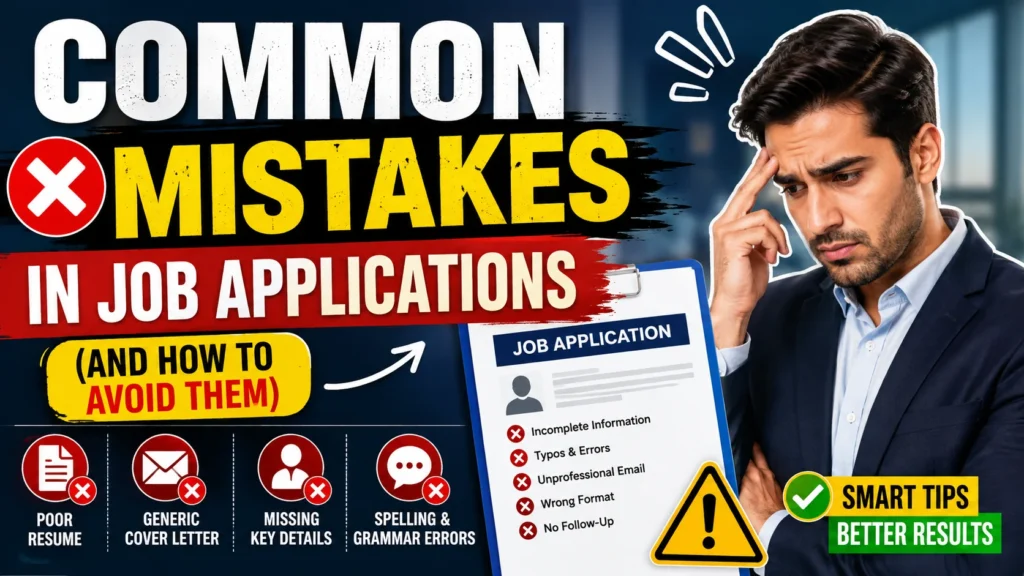
Common Mistakes in Job Applications. Milliers and Pakistan has over years thousands of well educated and capable men go unheard by job opportunities by the dint of mistakes made while submitting their application. A missing attested copy; a domicile expired on, the mismatch between the required fields on the form and C.V such things might sound trivial; yet they do make all difference for an otherwise most suitable candidate to be even considered for an interview for the job .This post highlights very frequent errors committed by job applications for both a public, a private sector job and other organizations like banks and the allied force department with solutions to prevent them.
Common Mistakes in Job Applications
1. Not Reading the Full Advertisement
This is definitely the most frequent error. Most people just glance at the title, the salary and maybe the last date and apply; and forget to read the whole advertisement properly. Usually, it is in the fine print that the:
- Real eligibility factors are listed any specific qualification.
- Age limit
- Residence requirement.
- Experience specification or required documents to be enclosed etc.
Such an error is not just cause for dis qualification but also a waste of time and application fee if any is prescribed. Always read an advertisement twice before applying and keep a checklist of all the requirements so you ensure you fulfill each one before you apply.
2. Applying With Mismatched Qualifications
How qualifications need to line up with recruitment. For any government department, the match to a “title” is a rigid one. For instance, an advertisement might state that you need “a Bachelor’s degree in Commerce” where you only happen to have obtained “a Bachelor’s degree in Commerce Business”.
During the review process you’ll get shot down even if you’re the most qualified person, simply because the degree is not a word-for-word match for what’s published in the advert (and the same applies to specific degrees, diplomas or certificates required by the ad).
Sometimes adverts include an “or equivalent”, which means you have a bit of room, but more don’t. Don’t guess, ring and check if you are uncertain.
3. Un-provided/Wrong documents
Applications are often put into pending/rejection because the user does not provide some documents or provides wrong documents like:
- Expiry date on the CNIC
- Expiry on domicile
- Unofficial attestation where needed
- Absent photos or certificates are some common examples.
- Blurry scanned documents or documents saved in a wrong file format can also cause rejection especially when apply online.
- All required documents, before the expiry date, need to be collated.
- Keep a check on expiry date of CNIC and domicile and try to get attestation beforehand.
4. Conflicting Information Between Documents
Any discrepancies in the details listed on your CV, application form and supporting documents, be it names, titles or work dates from your experience certificate, it is very likely to cause suspicion while being verified and can lead to your candidature becoming suspect. Always have your documents cross-checked carefully with each other before applying to maintain consistency.
5. Resume Writing Faux Pas
In general avoid sending the samecv.to jobs that obviously require candidates to meet completely different criteria. That makes it very difficult for a person screening candidates to rapidly decide why an individual is a right candidate for the job as some details might be buried or appear to be unimportant.
- Taking twenty minutes to adjust your CV for each application:
- Reordering sections
- Emphasizing relevant experience
- Matching some of the language used in the advertisement
- Significantly improves how your application comes across even though the underlying content doesn’t change much.
6. Waiting Until the Last Minute
Particularly government job application portals become terribly slow down in the last couple of days to the deadline, since several candidates access and apply. The candidates, who come to fill until the last time have the trouble where their application portal does not react, their payment challans become unproductive, and file upload applications do not responds up after timeout in times. You should apply as soon as possible after ensuring yourself as suitable and have documents prepared. There’s rarely any advantage to waiting, and it removes the risk of technical issues costing you the opportunity entirely.
7. Ignoring the Application Fee Process
It usually comes with the fee being payable through bank challan in case of many govt. Job application which seems simple but is not as simply like making bank challan, paying it by the due date, and then showing a verification confirmation on the portal before you become the candidate. Some of the students fill it and just miss on paying the due amount and get it verified and therefore, don’t ever become the candidate. Read out the fee payment instructions given in advertisement word to word and ensure, till your fee is verified and mentioned so on portal, consider the form not completely submitted.
8. Unprofessional or Inconsistent Email Address / Phone Number
Although it may seem trivial, that goofy email from High school will never fly for your private sector applications. Same goes for having a Google Voice account that you just can’t be bothered to update on occasion, especially given private sector recruiters can contact you directly from their resume software to schedule. (a basic named email and a valid phone number is just dandy.)
9. Not Preparing for the Selection Test or Interview
Also, your preparation and activities does not ends after application, test or after an interview. Don’t stop preparation.
- Preparing for Government Jobs: You should prepare your syllabus in depth, learn old question papers, practice general knowledge and general affairs topics.
- Preparing for the private sectors jobs: You should research about that company and position, and prepare to show how are you going to use your background and experience for the post.
10. Falling for Fake Job Postings
Be warned that online scams for positions of all types exist and especially job scams. Beware that a posted position offering cash to lock-in the opportunity and posting seeking personal details early in an application process often are jobs scams. Reputable and professional entities government or private do not charge fees to the candidates to work.
When applying, any place, particularly at unknown websites, and social media pages; be sure the information at posting agrees to information on their Web pages. Any odd red flags such as to fast hired; money is requested payment for job; unclear of any entity, is good reason for alarm.
11. Not Following Up Appropriately
- For private sector, often the applicant may receive no response. They have to either wait it out or assume it’s a done deal.
- Sending an polite follow-up email the first or second week after the deadline for the position closes may sometimes result in an answer, especially where a date was specified.
- One wouldn’t require this for a position in the public sector, because this hiring process remains highly regulated unlike in the private sector.
12. Overlooking Age Limits and Relaxation Categories
Age limits are a strict eligibility factor for most government jobs, and candidates sometimes either assume they don’t qualify when they actually do, or apply without realizing they’re over the limit. It’s worth checking not just the general age limit in the advertisement, but also whether any relaxation applies to your situation this can include categories for government employees already in service, people with disabilities, and certain reserved quotas.
Also Check: PPSC Jobs 2026 – Apply Online, Eligibility & Last Date
Avoid Most of These Mistakes
Many of the above errors boil down to a similar bad habit:
- Applying perfunctorily instead of making a focused effort on every application.
- It’s this tiny degree of regular discipline which differentiates those candidates who get short-listed from those who don’t, whose qualifications are quite comparable.
Final Thoughts
- No of these mistakes are difficult to avoid, once you’re acquainted of things like that which to steer clear of, but there can easily be overlooked when you’re putting in a number of applications for a range of job opportunities and looking toward a short due-date.
- Slowing down slightly at each stage reading carefully.
- Double checking documents.
- Adding tailor to your CV takes very little time and significantly increase your odds of successfully going through the screening stage where most applicants don’t manage to come out on.
Frequently Asked Questions
Most commonly encountered issue with job applications in Pakistan?
One of the major reason for such rejection is lack of matched and missing documents on record. This is followed by applicant’s failure to comply the criteria, as set down in advertised post for minimum qualification and age.
Is it okay to send the same CV for every application?
Ideally, for each and every job application, you will adapt your CV a little and make sure that your strongest qualities and experiences, that relate to that position, are highlighted.
Am I sure I possess the right qualification for the role posted?
If not what should I do? Don’t assume the qualification matches the post, please approach the HR department for clarification prior to submitting your application. This avoids rejection post evaluation.
Can I apply for a job where I need to pay the employer before an interview?
No, a genuine employer will never ask you to pay for anything before you’ve been made an offer for the position, so if it seems like one does, a warning bell should immediately sound out, as in all probability it is not authentic.
When should I fill out a job application before the deadline?
As soon as you can once all your documents are finalized and eligibility is clear online portals really become clogged on the last day or two of the deadline.